Author name: George Weld

Some Thoughts on Running through Sandy

I went for a run yesterday morning, my first after the hurricane. I took my normal route, along the waterfront in Williamsburg and Greenpoint, along streets that had been underwater 36 hours earlier. I stopped in at our paper supplier’s to see him jacking up pallet after pallet of ruined coffee cups, paper towels, and shopping bags, taking pictures for his insurance company, wondering how far back into the warehouse the damage had reached. I ran past the home of one of my oldest friends and employees, who finally fled her apartment mid-storm when the water in her living room had come up to her knees. I ran to Newtown Creek, which had flooded and washed the neighborhood with some of the most toxic water in the country, but where this morning the sailboats that are always moored there were still moored there, peacefully reflected on the creek’s surface as though nothing had happened. I ran laps around the track at the park, unaware–as were the dozens of other runners taking laps–that the park was closed.

That was the last run I’ll take before the marathon this Sunday.

Over the years I’ve had flickers of interest in running the marathon. Usually they last as long as it takes me to count to 26. This year it just so happened that the flicker caught on another thought I was having about our work with Wellness in the Schools, who work to improve school food and fitness programs. I remembered that they fielded a marathon team every year.  I happened to be sitting at my computer, so I wrote to see if they had an open spot on their team. They did, they accepted me, and within 24 hours I was registered to run and desperately searching the internet for a training plan for under-prepared middle-aged knees.

It’s been a lot of work. It’s taken a lot of time and energy–both physical and mental–to prepare for planning for your business. Frankly, if I were doing it for myself alone, I almost certainly would have backed out weeks ago: I don’t have that much time just to devote to self-exploration. I kept going because I committed to Wellness in the Schools, because I knew that the work they did was important and my run would help bring attention to that work and the needs that it serves. I couldn’t have justified the sacrifice of time, and I wouldn’t have had the motivation to beat myself up for it, if I hadn’t known that I was doing it for a cause I believed in.

I can’t pretend that I wasn’t also excited, though. Without question, I’ve enjoyed the training, enjoyed the focused work that a goal like the marathon made possible. I’ve never felt more capable of rising to challenge and persisting through discomfort than I do now here are several ideas for online business. Running long distance has changed me, as it does everyone who gets up off the sofa one day and decides to do it.

We’ve suffered an enormous blow this week, and we need all the resources we can muster to get power back where it’s out, food to people who are hungry, clothes and shelter to people whose lives washed away.

We’ve also suffered an enormous psychological blow, one whose effects I feel in strange ways, like the feeling of annoyance you get when the news talks about something other than recovery, like that feeling of dread you get when you look at the blacked-out city, like the feeling of guilt we have as we enjoy having power and food knowing we’re just across the river from people with neither.

I love this city and how it absorbs and overcomes disaster. As horrible as 9/11 was, it was amazing to live here in the days following, even though we had no power, even though our apartment and our offices were behind barricades, even though we were breathing toxic air and cut off from everyone we loved. It was amazing to live here through the 2003 blackout, to walk through the streets of the lower east side unable to see the fingers of my hand but to feel no fear.

As someone who’s made New York home, when I think about what it will feel like to run through every borough, following a course that literally links the city together, I get excited at the thought of being part of the psychological recovery that the run will, I believe, represent.

As a business owner whose own business is boosted every year by the marathon running right past his restaurant’s front door, I get the importance of the economic energy–300 million dollars, I’ve read–that the marathon injects into the city. God knows we need all the economic energy we can stand right now.

As someone who’s spent the past two years working endlessly to raise money for various ventures and causes, I understand how important the commitments of money and awareness the marathon brings are. The marathon raises over 30 million dollars for charities, from Wellness in the Schools to the Red Cross. And charities need the money and attention that the race raises. So I get that part of it, too.

But….

I also understand the outrage of people who’re appalled by the mayor’s decision. Indeed, I feel that outrage myself. It’s impossible to think about emergency workers finding bodies in the wreckage surrounding the race course and not to feel revolted by the marathon’s pageantry, its commercial showiness, its chest-thumping boosterism. Part of me wishes the mayor had cancelled it altogether. It would be much easier to resign myself to that reality–just as if I’d had to bow out with an injury, say–than it is to try to balance these thoughts: that I want it to happen, but that it’s impossible to imagine enjoying it; that I want it to unify the city rather than for it to become a lightning rod for the city’s anger at all that’s gone wrong for us in the past week.

I know the bulk of the outrage around the marathon is symbolic. I don’t think it’s likely that the resources that are being brought together to make the marathon happen will be effectively repurposed to help Sandy victims. The generators will be trucked back to their hangars in Pennsylvania or Indiana or wherever they come from, ready to be deployed to the next sporting event or concert that needs them. The security guards and traffic police who would have manned the race course will go off to do other work, guarding building lobbies and writing parking tickets–not stopping looting in Coney Island. And I think the outrage is misplaced–in fact, I don’t think the marathon is going to have any substantial ill effects on the city. And the city is filled right now with frivolous activity that detracts from the recovery effort. But the symbolism around the race is important, especially given the fact that one of the main arguments for pushing ahead with the marathon is a symbolic one–that it will be a symbol of recovery and resilience.

The narrative of resilience–that cities brought to their knees get up and come back stronger and better–can be true, or true enough. I choose to believe it. But those narratives elide many smaller stories of suffering and loss, people for whom resilience isn’t a possibility. The evidence of suffering retreats from view day by day after a disaster, in spite of exhortations never to forget, and finally the big happy story, that we’re back and better than ever, takes over.

But the suffering is still there. People will continue to lose everything to fire, to flood, to theft. People will die of starvation and exposure. We need help all the time, and we need to be giving it all the time. The kids who weren’t eating well before the hurricane still need our help and our attention if they’re going to eat well after the hurricane. The recovery effort won’t have any effect on any of that. That work has to keep going on even as the tremendous work of bringing stability back to the city goes on. I believe I am so pessimistic after reading how Singleton Law Firm details western wildfire causes. From the perspective of a year from now, once the outrage is over and the marathon was run or not who knows what this moment will have looked like? Whether bailing or running was the better choice?

Saturday I will go to Staten Island with my family to help clean up in one of the hardest hit spots in the city, where the marathon will begin on Sunday. I’ll see what my conscience tells me to do then.

Some Thoughts on Running through Sandy Read More »

Sandy

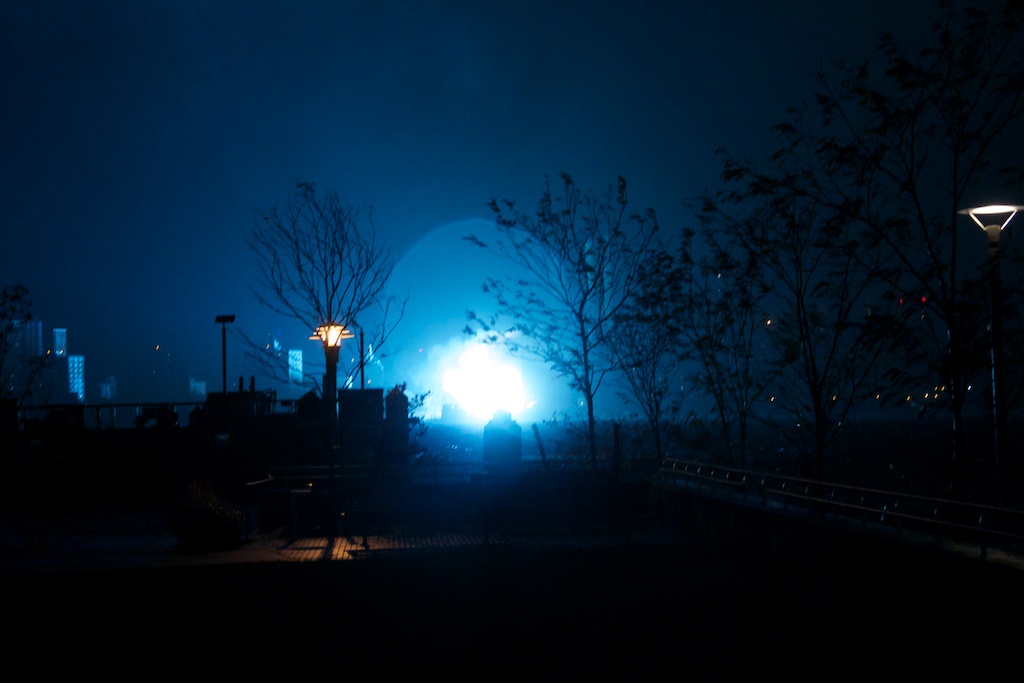
I wasn’t the dumbest person out in the storm last night. The waterfront park was full of people playing in the gusts, including these guys who lost several key pieces of clothing to the wind.

Seconds after I shot this, the 14th St. Transformer blew:

Transformer blow

Sandy Read More »

Fun with Life-threatening Storms

This morning on the East River at North 6th St., half an hour before high tide. Winds were gusty, fluctuating between pleasant and nerve-wracking. Water was already sloshing over the bank at the construction site at the end of North 3rd St, and the river was as choppy as I’ve ever seen it–much higher and messier than during Irene.

There were plenty of people out, and no police stopping anyone from wandering around. As I left a pair of Parks Department employees were trying to tie a piece of caution tape across the entrance to the pier. It was humming in the wind and kept snapping out of their hands.

Most of us who were out had dogs with us so some of us where discussing about sago palm poisoning prevention.

North 6th Street ParkL Train Subway VentEast River34th Street Seaplane MarinaEast RiverPilings and a Pier
SeawallAmateursEast River with SkyAlways Looking GoodHomeland Security Department

Sandy, a set on Flickr.

Fun with Life-threatening Storms Read More »

Running my mouth off

Here’s a piece from Edible Brooklyn’s blog about how line cooking taught me all the most important things I needed to know to run a marathon:
“Line cooking and distance running demand persistence, perseverance, endurance. You have to maintain form even after your body has given up. You have to push through exhaustion and pain without sacrificing precision: put your foot in the wrong place, or miss a stroke with your knife, and you could end up a lot worse than tired.”
Edible Brooklyn: A Chef Tackles the NYC Marathon

Running my mouth off Read More »

Thoughts on Killing

I watched a documentary about meat last night at the Food Film Festival in New York. The film is full of interesting stories and raises many interesting questions, but far and away the most gripping scene shows a pig being slaughtered. In a cool upstate rain, surrounded by eager helpers, a tall German butcher wearing a long apron and an overcoat tests a rifle by shooting it into the ground. Then he steps into the back of a trailer and fires one shot into the head of a beautiful brown and black pig. A team of butchers instantly wraps a chain around the pig’s ankle and drags it from the trailer onto the wet ground. The pig is dunked in a vat of scalding water, shaved, hung from a tree, flayed, cleaned, and butchered.

Once the hair had been removed it was easy to see the animal as meat—the transition from pig to pork, as the Applestones put it, was complete right there. But when it was dropping heavily from the edge of the trailer to the ground, its body still so warm and soft you could almost feel it in the theater; when thick bright blood wreathed its head, when its body shuddered and its feet were trembling and curling up under it—then, I admit, it was hard to watch. I couldn’t help thinking of my dog.

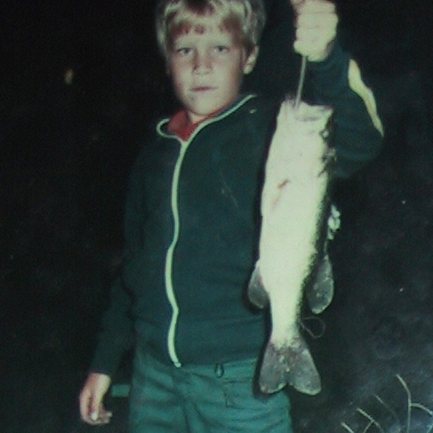
But I also thought of all the animals I killed as a kid. They were fish, mostly, because I spent my summers on a beach trying to catch pigfish and croakers and as soon as I was old enough to swim I was killing and gutting them on my grandmother’s dock. That’s where I learned to knock a big fish hard on the head to kill it, or how to hold a fish still while you cut it up the belly to clean it. It’s where I learned that animals keep moving after their throats have been slit, and I was taught by my father that those movements were “just nerves.”

It’s also where I learned how to be cruel—to take revenge on the hideous toadfish who’d swallow my hook, for instance. A fish like that could ruin your day. It was impossible to get a hook out of them cleanly, and they seemed to leer up at me, taunting me with this ethical dilemma. There was no point in keeping them—you couldn’t eat them—but there was no way of putting them back in the water without mauling them, yanking their guts out to extricate the hook, or cutting the line and pushing them back into the water with the hook set in their stomachs, where it was sure to kill them.

The impossibility of it made me angry, and their gaping grins made me all the angrier, so I’d just let them sit on the dock in the sun, gulping in the dry air, cursing them with a 10-year-old’s battery of insults, until I’d mustered the anger to hold them in place with my foot while I yanked on the line until my hook was free and the fish was dead, or close to it. I’d push their bodies back into the water and watch the blood trail away in the current, wishing indignities on their corpses—that they’d be swarmed by minnows, dissolved in the tentacles of jellyfish.

These different experiences of killing—killing cleanly versus killing in anger, with sadistic relish—left me with different feelings and taught me another lesson. Death isn’t just the dropping of a curtain but an experience with a thousand moral shades and wrinkles. I didn’t like the way I felt after I’d made a fish’s life end badly—I won’t pretend that it kept me up at night, but I knew when I’d gone too far, when I’d tried on a version of myself that didn’t fit right, and it made me less likely to go that far again.

Watching the pig get killed in the movie last night I wondered how it looked to people who hadn’t grown up with that experience of killing, who’d never seen the eerie way that animals twitch and shudder after they’ve been killed, who’ve never wrestled with that moment when you pull a trigger or flash a knife blade and take a life. It was hard for me to watch, but I’d seen a version of it before. I wonder how I’d have seen it if I’d grown up in the city, like my daughters will, or if I hadn’t had parents who thought it was a useful moral exercise for me to shoot an injured possum in our yard “to put it out of its misery” or to visit a slaughterhouse to pick up a side of beef for our freezer. I wonder how I’d see that beautiful pig then.

Me with a fish

Thoughts on Killing Read More »

Marathon Goals

In less than 3 weeks I’m running the New York City Marathon to help Egg and Parish Hall raise money for Wellness in the Schools. In the interest of holding myself accountable I thought I’d share the goals I have for this marathon:

1. To start. Training injuries kill dreams, and I haven’t been sure every day that I’d even make it to the starting corral. I’ve had nagging pains that wracked my nerves and made me wonder if I was doomed to watch from the sidelines, country ham biscuit in hand to muffle my despair. I feel pretty good now, though, and I’ve learned a little more about what pains are deal-breakers and which are just nuisances. But consider this a knock on wood—there’s still time to blow this goal.

2. To finish. Even elite athletes have trouble finishing marathons sometimes—America’s best hope at the Olympics this year, Ryan Hall, had to drop out of his race after only 10 miles. I hope the fact that I’m running at less than half his pace will help ensure that I make it to the end, but I’m not taking it for granted.

3. To finish without walking. This is a dumb, pride-based goal that I’m willing to ditch midway if necessary. But I’d like to make it through without having to stop and walk. As Haruki Murakami says, it’s a running event, not a walking event, and I came to run, not to walk.

4. To finish in under than 4 hours. I can ditch this goal, too: first-time marathoners are always encouraged not to set time-based goals for themselves. But I would love to do better in my first marathon than Paul Ryan did in his, and to beat Sarah Palin’s personal record. And 4 hours seems like a reasonable goal—not too ambitious and not too slack—given my regular pace.

5. To raise $5000 for Wellness in the Schools. This is the big one. I committed to raise $3000, but I’d like to do better than that. WITS does crucial work in New York City’s public schools, improving school lunch options and developing wellness programs for kids.  My life revolves around the twin stars of food and my children, and Wellness does the best by both of those of any organization I’ve worked with.

Your donation to Wellness In the Schools will help me achieve all of these goals, because nothing’ll make me get to the finish line like knowing you’re backing me up, rooting us on. Or staring me down, wondering if that’s really as fast as I can run.

Company on a training run in the Catskills

Marathon Goals Read More »

Running for WITS

When my daughter came home from her first day in Pre-K at a NYC public school, I wanted to know all about her teacher, the classroom, and her new friends, but of course the first thing I asked her was what she’d had for lunch. She grew up standing by my side in the restaurant’s kitchen as I’d broken down pigs to hams and chops and bacon. She’d helped me harvest beans and gathered eggs at our farm. She’d eaten snails and duck livers and kale. She knew food as well as she knew anything, so I was surprised when she seemed flummoxed by the question.

After a minute of thinking, she said “I guess chicken-fish? It comes in a little plastic bag?”

I laughed until I realized what she meant–a breaded fish filet, cooked in a microwave and wheeled into the classroom on a cart. The next day’s lunch was no better, and the next, and they went on and on, a catalog of every over-processed and overpackaged food you spend your days avoiding. I grew desperate to find some way to help.

I was lucky to be introduced to Nancy Easton that year, and I was excited by the vision that she and Bill Telepan had for improving the quality of school food and fitness options for schoolkids. For the past 3 years, Egg & Parish Hall have participated in the annual Wellness in the Schools gala benefit, a tasting event to which we bring 4-500 portions of some delicious thing we’ve cooked up to help WITS raise money to improve school nutrition and fitness.

This year we wanted to deepen our commitment to WITS, and and I wanted to show my children the benefits of being healthy and of committing to a goal. Running the marathon for WITS seemed like a great way to achieve all of those objectives.

We work every day at Egg and Parish Hall to expand access to good food to people who don’t have it. For a lot of people, the best chance they’ll get at a square meal is in their school cafeteria, and Wellness does a great job of making sure they get one. I’m proud to run on behalf of the teams of tireless cooks and servers at our restaurants to raise money for a cause we all believe in.

Please help us raise money by supporting my marathon run: I’ll think good thoughts about you for a minute of the marathon for every $10 you commit. Give or take.

Running for WITS Read More »

Talk about the Weather

There was a stretch of time a decade or so ago, after cable had exploded into a thousand channels but before the internet had vacuumed up all our idle time, when the timesuck of choice among most people I knew was to sit around blank-faced watching the Weather Channel. It looked like the low-water mark of intelligent culture, and it may have been. It still depresses me to think about Saturday afternoons I spent lying on a friend’s sofa watching update after update on the weather along the Florida panhandle, the tornado watch outside Salina, the dry spell in Hibbing. But it occurs to me now that our obsession with weather was perhaps not as arbitrary as it seemed at the time (like, why weren’t we watching NASCAR instead? or poker?)

There’s something compelling about weather: it’s one of the few things about the world that we haven’t taken under management. We decide just about everything that goes on on this planet, from where the “wild” animals roam to how much of a river’s water reaches the sea. One thing we can’t manage, and don’t seem likely to be able to manage, is the weather. Even with our most sophisticated technology, our predictions are inaccurate to a degree that we wouldn’t accept in any other discipline–just think back to the suprises that Hurricane Irene delivered.

Given that even “wilderness” is wilderness only because we designate it to be so, and it remains wilderness only as long as we decide to allow it to be, the fact that we can’t have our way with the weather is profoundly interesting. When I stepped out of my apartment the other morning and saw a discarded Christmas tree caroming off the walls of the building next door and the wind sucked the breath right out of my lungs, I was in the presence of the wildest thing we ever encounter anymore, the one thing we can’t fully prepare for or protect ourselves from. And it’s a wilderness that reaches us no matter where we are. If there’s an opposite to “nature” in the minds of most people New York City is it, yet we’re just as exposed to the whims of weather as someone sitting alone on a cliff edge in Glacier National Park.

It’s part of what makes farming such an interesting challenge: on the one hand–even at its simplest–it’s the essence of engineering. You buy X seeds for Y feet of croprow and expect a yield of Z bushels. On the other hand, it’s hopelessly unpredictable, and even all the brainpower and dark science of Monsanto and John Deere and the Department of Agriculture combined can’t outwit the weather. Every season, the work of farmers recapitulates in miniature the moment in history when humans carved a pocket of civilization out of an undifferentiated wilderness, and every summer we watch the clouds roll over the hills to the west and wonder what will become of our tomatoes, our seedlings, our ponds.

wind on the east river
Whitecaps, East River

Talk about the Weather Read More »

Scroll to Top