I grew up mostly in small southern towns. My life was enmeshed with church—my father the priest, my mother the organist—whether I liked it or not.
I developed such a distaste for the church that it took me a long time to realize how profoundly it had shaped my sense of what art could be. In a church service, modes we keep separate in everyday life are twined together. Language is used in many registers, from the informal language of the week’s announcements to the ornate diction of the lectionary readings. It blurs into chant during prayers; it lifts into song during hymns. The music in one moment is high-German Baroque, Southern folk the next. And so many forms of ritual and performance, and the magic of light streaming through stained glass windows, the angle of that light rising toward vertical as the morning wears on. I can still feel in my body how, during a service, the movement of light changed my sense of physical space and how it raked my emotions across that space as it moved.
One effect of these experiences was to make me skeptical of the way we segregate arts from one another, both as readers, listeners, or viewers, and as practitioners or makers. I have tried to pick just one mode—music first, then writing—but I’ve always felt restless. I’ve tried turning my energy to practical ends: I tried making things interesting with computers in the early years of the internet; later I turned to food, cooking and running restaurants and a farm. I couldn’t quite get settled. Finally I’ve come to accept that’s just how I am, how I want to work.
I had plenty of more conventional experiences with art that shaped me, too: reading and writing, listening to and playing music, taking pictures when I could afford film and drawing when I couldn’t. But church was the matrix that all those other experiences plugged in to, and, in some way I’m still figuring out, the model for the kind of work I want to make.
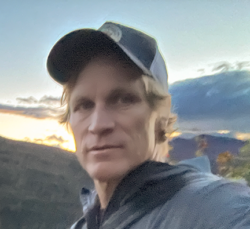
A more formal bio:
George Weld works primarily in writing, photography, and food. He is the co-author, with Raymond Meeks, of The Inhabitants (Mack, 2023), author, with Evan Hanczor, of Breakfast (Rizzoli, 2015) and a contributor to the books New York Diaries (Modern Library, 2012), The New Brooklyn Cookbook (Morrow, 2010), Raymond Meeks’s Ciprian Honey Cathedral (Mack 2020), and Adrianna Ault’s Levee (Void 2023). His writing about photography, food, and poetry has appeared in Trigger, New York Review of Books, Lucky Peach, Agni, Edible Brooklyn, and the Boston Book Review. He was the invited writer for the Journal of Grievances, vol 4 (Antics Press, 2022), edited by Judith Black and the ImageThreads Collective.
He has a master’s degree in Creative Writing from Boston University, where he studied with Derek Walcott and Robert Pinsky before doing doctoral work in literature at the University of Virginia.
He was a member of the 2025 cohort of Penumbra’s Long Term Project: Photobook. He has taught writing at Boston University, the University of Virginia, and the Penumbra Foundation.
He also created the restaurants Egg, Parish Hall, Egg Tokyo, and Hash Bar, as well as the Catskills-based Goatfell Farm.
He lives in the Hudson Valley.
@georgeweld everywhere else.